
Islam can survive the current backlash

http://i.telegraph.co.uk/multimedia/archive/02703/saudi-eid_2703921b.jpg
Muslims descend to Mecca for Eid al-Adha (Image: The Telegraph)

I woke up yesterday morning disappointed in The Times newspaper. I don't often act this way towards a publication which I've proudly subscribed to for nearly five years. However, splashed on their Bank Holiday front cover read 'Christian child forced into Muslim foster care'. While any child forced into doing something they don't want is disturbing to say the least, I thought for them to explicitly include religion was a cheap shot.

The story itself was an investigative piece. It describes a five year old girl's six month foster journey, living with a family which their second language is English. The family happened to also follow the Islamic faith and obeyed the rules the religion apparently follows. The girl was reportedly banned from eating a bacon carbonara, had a cross necklace removed and was encouraged to learn Arabic. The local authority, in Tower Hamlets in east London, refused to comment on The Times' claims, but the paper had dedicated a lot of time and space to describe the so-called horror the little girl endured. Since then, the story has spread like wildfire. Of course, the Daily Mail later escalated it further with their own investigations about the same story.

Should these claims be true - that the girl was clearly distressed by her previous six months living in a home she felt uncomfortable in - then I appreciate the case being reported and taken seriously. As The Times rightly state, 51,800 children were in foster placements last year. Every case is different and should be approached sensitively too - for both the child and foster family. Administrative errors can take place too. As much as we'd like to think the foster system is perfect, just like the care system towards the elderly and A&E incidents, there will always be issues. Whether some of these are due to religious grounds, considering the current sensitivities surrounding faith, heightening this over other potential grounds, is a dangerous notion.

https://i1.wp.com/www.isetnews.com/wp-content/uploads/2017/08/Times-front-page.-Monday-28th-August-2017-Newspaper-MondayThoughts-paperstoday-bbcpapers-tomorrowspaperstoday.jpg?fit=320%2C391&ssl=1
The Times on Monday 28th August 2017
I can't talk for The Times by second guessing what possessed them to splash this particular story on their front page. Neither should we be actively seeking the reasons why this girl in question was placed in the fostering system in the first place. This wasn't explained in the original story. I can however, question whether this particular story is in the public interest. They could have written a story in how there have been issues regarding the fostering system - like the paper had this morning. They also touched on this on page six of the Bank Holiday publication, but unless you spend £1.60 on the paper, you're just going to see that those who follow the Islamic faith are troublesome - again.

Islam, as a religion, has had tough publicity to counter this century. Some argue it's been tough on them since just after the Second World War, but it has certainly escalated since 9/11 - which occurred nearly exactly sixteen years ago. The rise of use in digital and social media channels has heated the debate. Because of these, Islam has been targeted in terms of being blamed for mindless attacks across the world, in addition to the religion being the cause of every other crises the globe is facing today.

These crises taking place are heightened today like there's no tomorrow. It appears as if leaders of the Islamic faith spend more of their time promoting the good the religion than doing their day job. I'm certain the vast majority of Muslims would like to pray and hope for world peace without the thought of being vilified by those who fail to realise there is more than one side to a story.

My key message to those bewildered as to why the Islamic faith is facing constant widespread hate is to not sweat. This may be a bad time for the faith's public reputation. However, those who actively follow the faith aren't the only section of society that have been targeted in such a vicious way - whether from press or people who don't see eye-to-eye with how they see the world.
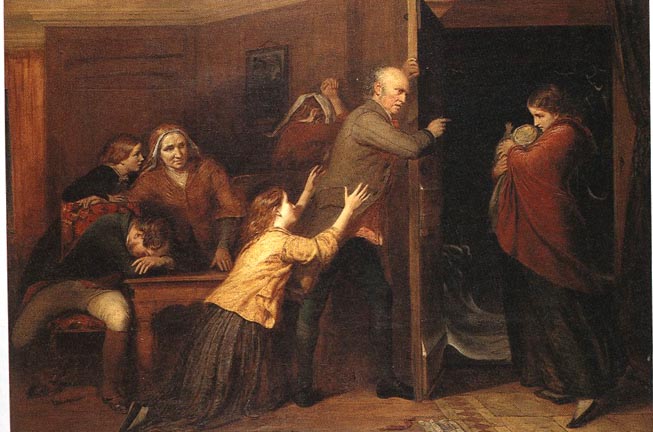
The Outcast (1851) shows how illegitimate children were treated
Through education in history, and as a keen viewer of BBC One's Who Do You Think You Are? and ITV's Long Lost Family, I have followed how Catholics and Protestants publicly fought for decades over nationalism and land ownership. Both religions were equally on the back end of torrid abuse by non-believers and the media alike. Most Catholics and Protestants today can be in the same room without being at each other's throats. I have followed how unmarried women get shunned in communities after giving birth to a child - 'bastard children' their boys or girls would be often called. Having a child 'illegitimately' was ferociously frowned upon until only recently. We take that for granted today. And who could forget about how people who follow the Jewish faith, and black people were treated for centuries. Thankfully, they're largely welcomed in society after decades and decades of horrendous and unjust publicity.

With time, Islam can see it through the other side. It starts by not treating religion as if it's dirt. Islam, like Christianity, has been followed for centuries - occasionally without peace, of course. However, if it rocks that person's boat to follow what they believe in, who dares to stop them? I'm certainly not going to stop anyone from celebrating Eid al-Adha this Thursday and Friday (31st August and 1st September). As long as none of us are abusing our right by hurting others, we should do what we need to do. If that foster family reported in The Times don't eat bacon and wear specific garments, it really isn't a big deal. The girl, due to her young age, cannot defend claims about her unhappiness, so I felt therefore the entire case could have been dealt with privately and avoiding prejudice.

Without sounding like a broken record, if we do things without judgement, it would inspire the rest of the world to follow suit. Living a life without ignorance would lead to an easier life, wouldn't it?

Comments

Popular posts from this blog

We've got the whole world, in Trump's hands

Donald Trump is cornering a willing Keir Starmer (Image: Getty Images) I yearn to visit the United States one day. I have it all planned out - seven cities across seven states, at least three nights in each. And each seven locations have meaning, influenced by my interest in TV, film, music and politics - plus a bit of sunshine and beach in the middle. In my mind, it will be the ultimate adventure, perfect for me, someone who isn't big on travel beyond European cities. However, I face two obstacles to this US trip - one, finances. I totted up how much it would cost me, and if you consider flights, hotels, food and other spending money, it will cost around £5,000, five grand I do not have and probably won't have for a good while. And secondly, the politics, which keeps reaching new levels of volatility. So much so, if its President, Donald Trump, carries on, we'll be comparing the US to North Korea and Iran.  I may sound extreme, but when you consider incidents like the deat...

Done right, digital IDs can save lives

Sir Keir Starmer has a challenge to convince people over digital ID plans (Image: The Guardian) If we're to treat survey results as gospel, I find myself in the minority on a big debate. It appears I am one of the very few in support of a 'digital ID' . It had taken me a while to come to this conclusion as, since the idea was explored under Tony Blair's government in 2005, I really wasn't sure what the point of the concept was. But 18 years later, I feel that an identification of some digital kind is necessary, and potentially lifesaving, as I'll explain here. The digital ID has been brought into the British political limelight again thanks to Prime Minister Sir Keir Starmer. He wants to bring them in on a mandatory basis, as a way of proving we have a right to work in the UK. It forms part of his cunning plan to halt illegal migration and illegal labour - similar schemes are already in place abroad and are said to be doing well. According to a government pres...

The death of British middle-class sit-coms

After 120 episodes spanning 11 years, BBC One hit situation comedy My Family reaches its final hurdle this Friday evening. BBC One Programme Controller, Danny Cohen said the channel are searching for a new generation of comedies which will created a similar impact. "Now that all the Harper children have fled the nest we feel it's time to make room for new comedies on BBC One. I can confirm that the eleventh series, coming to BBC One later this year, will be the last," Danny Cohen, March 2011 Ben and Susan Harper, along with their children, Michael, Janey and up until series five, Nick are the well-known faces we are going to miss seeing on the occasional Friday nights. Robert Lindsay and Zoe Wanamaker have made their impact on the small screen as well as theatre appearances which made them the big stars they are today and I'm sure Daniela Denby-Ashe (Janey), Gabriel Thomson (Michael) and even Tayler Marshall (who played Janey's son Kenzo) have a big futu...